
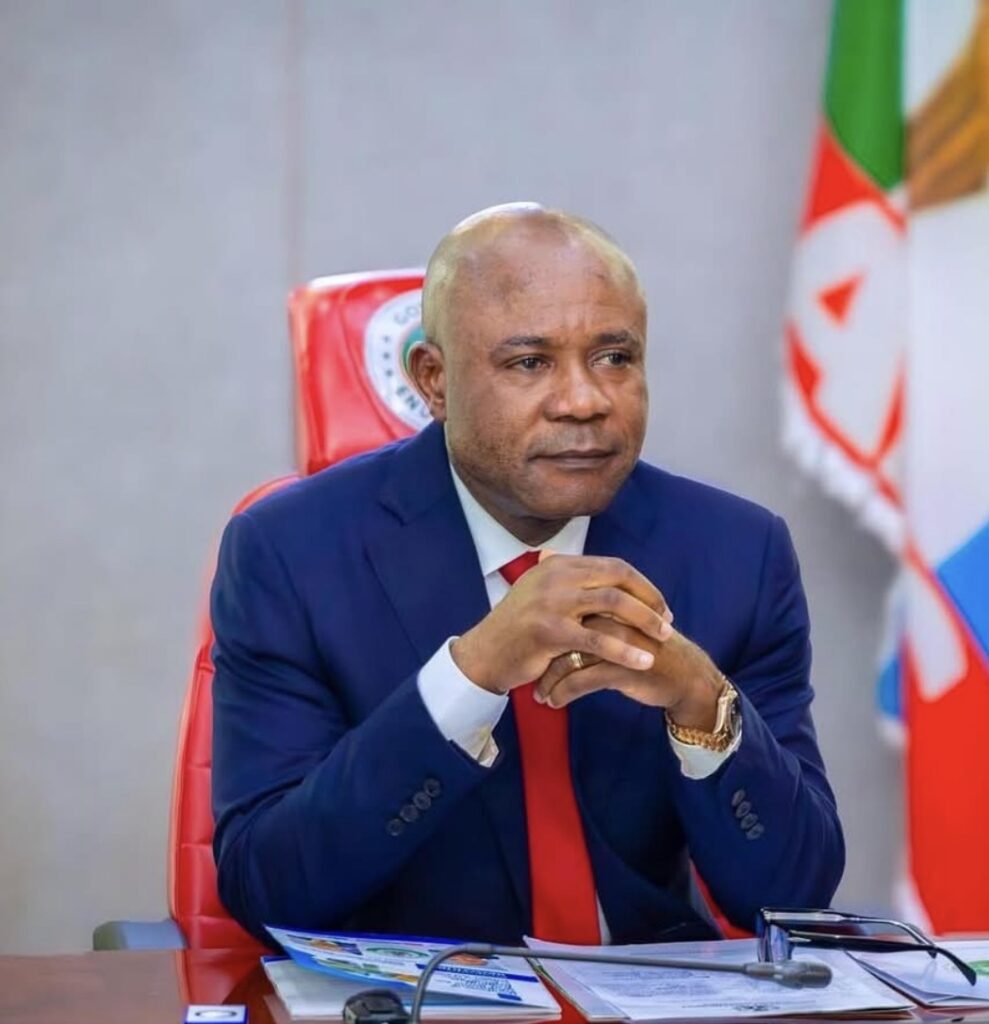

Enugu State Governor, Peter Mbah, on Tuesday officially presented a ₦1.62tn budget proposal for 2026 to the Enugu State House of Assembly.
In a release from the governor’s media office, Mbah described it as the state’s movement “from laying foundations to scaling transformation across every sector.”
The proposed budget tagged ‘Budget of Renewed Momentum,’ shows a 66.5 per cent rise from the revised ₦971bn 2025 budget.
According to the governor, the spending plan sets aside ₦1.296tn for capital projects, accounting for 80 per cent of the total budget, while recurrent expenditure stands at ₦321.3 bn (20%).
“We are scaling up. This budget is about momentum, renewed momentum and the determination to transform Enugu State sustainably,” Mbah said.
The administration expects ₦870bn to be generated from Internally Generated Revenue (IGR), ₦387bn from the Federation Account Allocation Committee (FAAC), and ₦329bn from capital receipts.
A breakdown of sectoral allocations indicates that the Economic Sector will receive ₦825.9 billion (51%), the Social Sector ₦644.7 billion (40.1%), while Administration, Justice, and Regional sectors are allocated ₦128 billion, ₦15.8 billion, and ₦2 billion respectively.
“Allocating ₦825.9 billion to the Economic Sector is both strategic and deliberate,” the governor stated.
“When we invest in agriculture, industry, and trade, we create jobs, reduce poverty, and generate revenue that strengthens the entire economy. The performance of this sector remains central to our vision of achieving a seven-fold GDP growth in Enugu State,” he added
Mbah according to the statement outlined a far-reaching infrastructure plan, including the construction of 1,200 urban roads and numerous rural roads.
The state also plans to complete ongoing flagship projects such as: “The 40km Owo–Ubahu–Amankanu–Neke–Ikem dual carriageway
“Dualisation of the Abakpa Nike–Ugwogo Nike–Ekwegbe–Opi–Nsukka Road. The 21.65km Enugu–Abakaliki Expressway.”
On transportation, he announced the state’s intention to expand its airline, Enugu Air, to a 20-aircraft fleet.
“We are acquiring 14 additional aircraft. Three of these will arrive before the end of 2025,” Mbah disclosed.
The state will also build five more modern transport terminals in Emene, Udi, Awgu, Four-Corners (Ozalla), and Obollo-Afor, alongside increased investments in mass housing.
The state will intensify efforts to establish 20-hectare farm estates across all 260 wards.
“We already have several farm estates under construction. Agriculture remains a backbone of our productivity agenda,” Mbah said.
He added that the New Enugu City project will receive strong infrastructural backing, and 15% of the budget is earmarked for constructing 15,000 mass housing units.
The social sector received key focus, with education taking 32.27 per cent of the entire budget — consistent with the administration’s recent prioritization of education.
“With 260 Smart Green Schools already completed or nearing completion, we will now move to build Smart Secondary Schools and Technical and Vocational Education Training (TVET) Colleges,” Mbah said.
He defended the heavy investment in education, saying “there are some who might look at what we spend on education and cringe. But what we spend currently is insignificant compared to the future social cost of having a disproportionate population of out-of-school children.” Health will receive 10% of the budget, while ₦11 billion has been set aside for expanding the state’s security surveillance system.
Mbah also announced a ₦20 billion allocation to clear longstanding gratuities inherited from previous administrations.
“Our workers should not wait years to receive benefits they have earned,” he said.
Giving an update on the 2025 budget implementation, the governor revealed that the state has spent about ₦806 billion so far.
“This means we utilized 97.5% of all money that came into the state and achieved 83% budget implementation,” he said.
On revenue, Mbah reported that the state’s IGR is projected to exceed ₦400 billion by year-end — a record figure he described as “a 221.6% increase over 2024.”
“The money coming into Enugu State has grown in ways we have never seen before,” he noted.
He attributed part of this revenue boost to President Bola Tinubu’s economic reforms.
“Our FAAC inflow exceeded expectations by more than half. We projected ₦150 billion but received ₦230 billion — over 50% above projection,” he said.
“This is not accidental. It reflects the impact of President Bola Ahmed Tinubu’s bold economic reforms. The removal of fuel subsidies, unification of foreign exchange rates, and other fiscal measures have strengthened key macro indicators. Inflation has declined, interest rates have eased, the exchange rate has stabilised, and our foreign reserve recently hit the $46 billion mark.”
Mbah concluded that the 2026 budget is designed to consolidate the gains of the past two years and accelerate development across the state.
“This is not just a budget; it is a blueprint for sustained transformation,” he said.