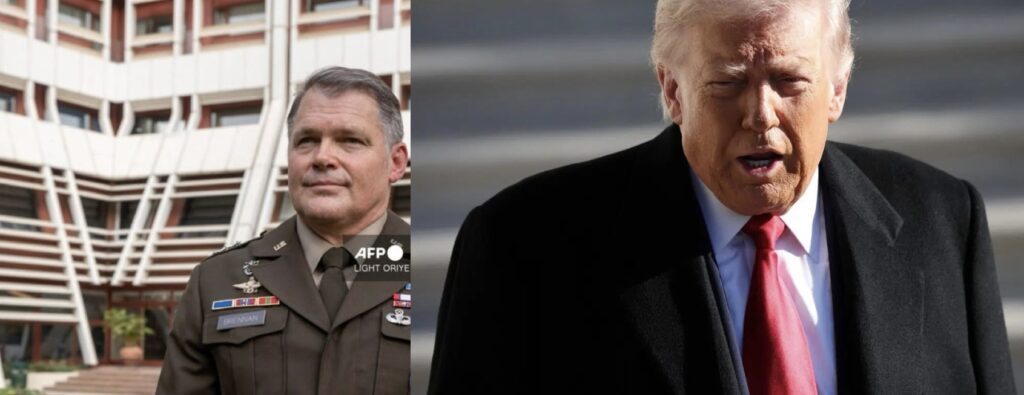

The US military is ramping up materiel supplies and intelligence cooperation with Nigeria, Africom’s deputy commander told AFP, as part of a wider American effort to partner with African forces in targeting Islamic State-linked militants.
The Pentagon has also maintained communication channels with the militaries of junta-led Sahel nations Burkina Faso, Niger, and Mali, Lieutenant General John Brennan said.
The strengthened cooperation with Abuja comes after Washington applied diplomatic pressure over jihadist violence in Nigeria, and also as the US military becomes “more aggressive” in pursuing IS-linked targets across the continent.
Under the Trump administration, “we’ve gotten a lot more aggressive and (are) working with partners to target, kinetically, the threats, mainly ISIS,” Brennan said during an interview on the sidelines of a US-Nigeria security meeting held in the Nigerian capital last week.
“From Somalia to Nigeria, the problem set is connected. So we’re trying to take it apart and then provide partners with the information they need,” he added.
“It’s been about more enabling partners and then providing them equipment and capabilities with less restrictions so that they can be more successful.”
Last week’s first-ever US-Nigeria Joint Working Group meeting took place roughly a month after the US announced surprise Christmas Day strikes on IS-linked targets in northwest Nigeria.
Diplomatic clash
While both militaries appear eager to expand cooperation following the joint strikes, the relationship remains clouded by diplomatic pressure from Washington over what Trump describes as the mass killing of Christians in Nigeria.
Abuja and independent analysts reject that portrayal of Nigeria’s complex and overlapping conflicts, a narrative long promoted by the US religious right.
Political tensions were evident at the Joint Working Group meeting in Abuja, where Allison Hooker, the number three official at the State Department, urged the Nigerian government “to protect Christians” in a speech that made no reference to Muslim victims of armed groups.
Africa’s most populous nation is almost evenly divided between a largely Muslim north and a mostly Christian south. Although millions coexist peacefully, religious and ethnic identity remains a sensitive issue in a country with a long history of sectarian violence.
Brennan told AFP that US intelligence sharing would not be restricted to protecting Christians.
He also said that after the US strikes in northwestern Sokoto state, future American support would focus on intelligence sharing to assist Nigerian air operations there, as well as in the northeast, where a jihadist insurgency by Boko Haram and its breakaway rival ISWAP has raged since 2009.
Islamic State West Africa Province (ISWAP) is “our most concerning group”, he said.
Analysts have tracked US intelligence flights over Nigeria in recent months, though some have questioned whether air support alone can defeat armed groups that thrive amid widespread poverty and the collapse of state authority in rural regions.
Still collaborate with AES militaries
Going forward, US-Nigerian cooperation will cover “the whole gamut of intel sharing, sharing… tactics, techniques, and procedures, as well as enabling them to procure more equipment,” Brennan said.
The initial strikes targeted militants linked to Islamic State Sahel Province, usually active in neighbouring Niger, according to Brennan.
Analysts have raised alarms over ISSP’s expansion from the Sahel into coastal West African countries such as Nigeria.
The effects of the strikes remain unclear, however, with both local and international journalists unable to verify militant casualties.
When asked about their impact, Nigerian information minister Mohammed Idris said last week it was “still a work in progress”.
Across the wider Sahel, Brennan said “we still collaborate” with the junta-led governments of Burkina Faso, Mali and Niger, which have broken from their West African neighbours and largely distanced themselves from the West.
Security cooperation was reduced after coups removed civilian governments in the three countries between 2020 and 2023.
“We have actually shared information with some of them to attack key terrorist targets,” he said. “We still talk to our military partners across the Sahelian states, even though it’s not official.”
Brennan also said the US is not aiming to replace its bases in Niger after American troops were forced out by the ruling junta.
“We’re not in the market to create a drone base anywhere,” he said, referring to the closed US drone facility in Agadez.
“We are much more focused on getting capability to the right place at the right time and then leaving. We don’t seek long-term basing in any of the western African countries.”
AFP